You wake up and half your face is numb. Or your lip twitches on its own. Or your eyelid has been twitching for three days straight.
Your first reaction is panic: “Is it a stroke?”
You rush to the hospital, get a CT scan, an MRI, and blood tests. Everything is normal. The neurologist rules out structural causes and mentions a possibility you’ve never heard of: Functional Neurological Disorder (FND).
Most Common Facial Symptoms in FND
The face is one of the areas with the richest neural representation in the brain. It’s no surprise that FND often manifests in the face. The most common symptoms:
Facial numbness. Usually unilateral, affecting the cheek, lips, and sometimes the tongue. The sensation is one of numbness—as if the area were “frozen”—but the person can move normally. This distinguishes it from Bell’s palsy or a stroke, where there is associated motor weakness.
Facial spasms and tremors. Involuntary contractions of the lips, eyelids, or cheeks. Their intensity varies depending on stress levels and the attention paid to the symptom. A characteristic feature: the spasm lessens or disappears when the person is distracted.
Functional ptosis. Drooping of the eyelid that comes and goes. Unlike neurological ptosis (such as in myasthenia gravis), functional ptosis improves with distraction maneuvers and does not progressively worsen throughout the day.
Atypical facial pain. A burning, pressure, or shock-like sensation in the face with no identifiable dental or neurological cause. Trigeminal nerve tests are normal.
Why Is the Face So Severely Affected in FND?
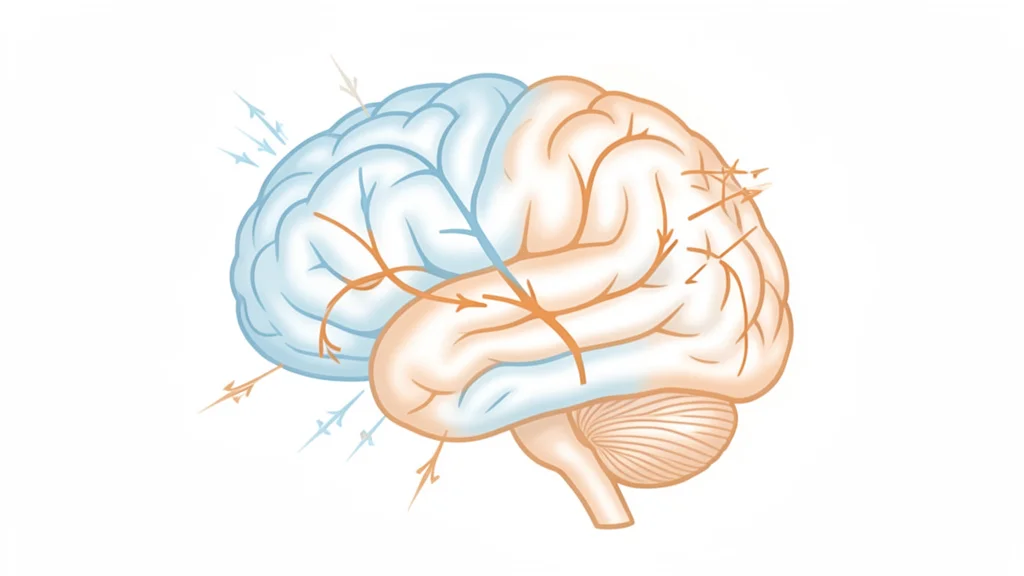
The facial motor cortex occupies a disproportionately large area of the brain. The face has bilateral representation—each hemisphere controls both sides of the face (unlike the limbs, which have contralateral control).
This complexity of innervation makes the face particularly vulnerable to functional “short circuits.” The brain system that controls facial expression, speech, and facial sensation is highly integrated—a software glitch at any point can trigger a cascade of symptoms.

How to Differentiate It from a Stroke
This is the question every patient asks—and rightly so. Practical differences:
| Characteristic | Functional FND | Stroke |
|---|---|---|
| Muscle weakness | Rare (numbness without paralysis) | Present |
| Forehead symmetry | Preserved | Impaired |
| Change with distraction | Improves | Does not change |
| Imaging tests | Normal | Abnormal |
If you have sudden facial symptoms, always seek emergency care first to rule out a stroke. The diagnosis of FND is one of exclusion—it is made only after structural causes have been ruled out.

Treatment That Works
Functional facial physical therapy. Specific exercises that retrain facial motor control, focusing on desensitization and reducing hypervigilance. See the evidence on CBT for FND.
CBT with gradual exposure. Many patients develop a fear of leaving home because of visible facial symptoms. CBT employs progressive exposure and cognitive restructuring.
Mirror biofeedback. A powerful technique: the patient observes their own face in a mirror while practicing movements, learning to dissociate the abnormal sensation from preserved motor function.
Hypnotherapy. Grounding and sensory anchoring techniques help reduce the intensity of spasms and numbness, especially when there is an associated anxiety component.

Frequently Asked Questions
Can facial numbness in FND be mistaken for a stroke?
Yes—which is why the recommendation is to always go to the emergency room first. Only after ruling out vascular causes is a functional diagnosis considered. The practical difference: in FND, muscle strength is preserved and the symptom varies with concentration.
Are the facial symptoms of FND permanent?
No. Most patients experience complete or nearly complete remission with appropriate treatment. Functional facial numbness is usually one of the FND symptoms that responds best to therapy.
How long does it take to notice a difference with facial physical therapy?
Initial improvements within 3 to 5 sessions. Significant results after 6 to 8 weeks of consistent treatment.
How can you explain to others that it’s not “just being dramatic” or a stroke?
“My brain is sending the wrong signals to my face—it’s not a stroke, it’s not paralysis; it’s a neurological glitch that can be treated.” Read about how to explain FND to your family.
Is your face sending messages you didn’t ask for? Don’t ignore it. And don’t accept “it’s nothing” as the final answer.
Schedule a conversation. FND Hope and Neurosymptoms have resources on facial symptoms in FND.