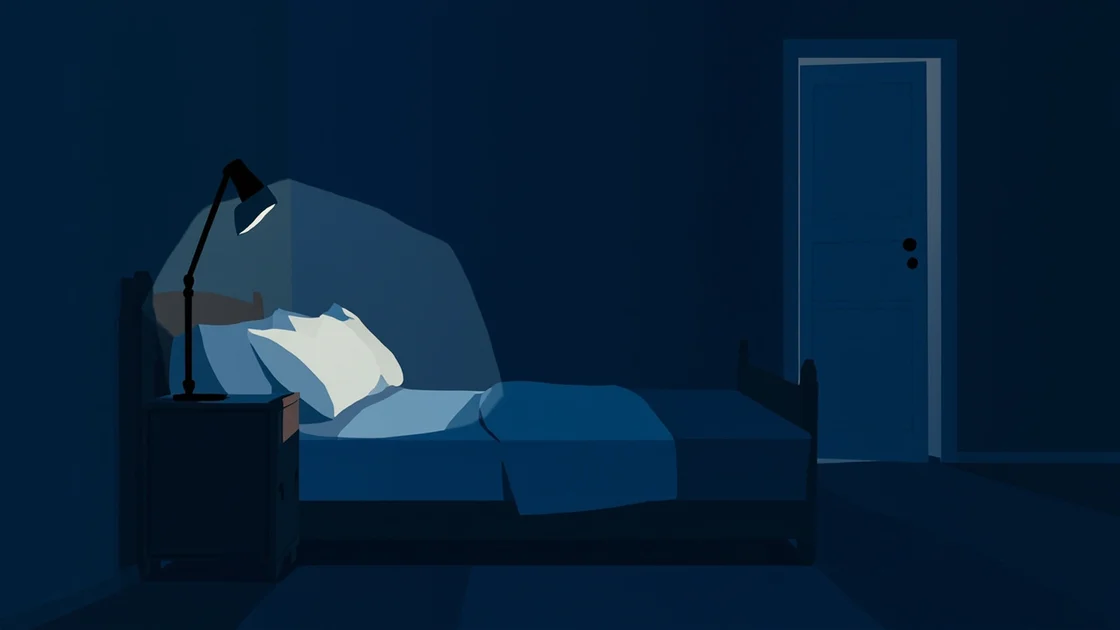

Lying down and feeling your body switch to alert, rather than wind down, is something many people recognise. Cleveland Clinic estimates that more than 40 million adults in the United States live with a chronic sleep disorder (Cleveland Clinic, 2022). For some of these people, the problem is not a lack of sleep but the fear of falling asleep. That fear has a clinical name: somniphobia, also called hypnophobia. People who live with it put off going to bed, keep the light on, and feel their heart race at the thought of closing their eyes. This article explains what somniphobia is, how it differs from insomnia and night terrors, why it tends to peak at night, and which steps help you sleep again. For the wider sleep picture, see how hypnotherapy is used for insomnia.
Key points
- Somniphobia is an intense fear of falling asleep, not a lack of sleep; putting off bed is the central sign.
- Gradual exposure is the first-line approach and benefits more than 90% of people who try it (Sleep Foundation, 2026).
- Seek help when there is panic, sustained sleep loss, or nightmares linked to trauma.
On this page
- What somniphobia is
- Is somniphobia the same as insomnia or night terrors?
- Why does the fear show up at bedtime?
- Is sleep anxiety the same as somniphobia?
- How to start sleeping again
- When should you get professional help?
- Frequently asked questions
- Conclusion
- About the author
What somniphobia is
Somniphobia is the extreme fear of sleep, also known as hypnophobia (Cleveland Clinic, 2022). It is not an inability to sleep, but a dread of the act of falling asleep, often through fear of losing control, of not waking, or of returning to nightmares. An estimated 12.5% of US adults have a specific phobia at some point in life (NIMH). The same framing applies to situational fears such as fear of the dentist, where avoidance is organised around one specific setting.
On the psychological side, the signs include intense distress at the thought of sleep, avoiding bedtime, irritability, trouble concentrating, and keeping a light or the television on all night. The body joins in: shortness of breath, chest tightness, cold sweats, hyperventilation, a raised heart rate, nausea, and trembling (Cleveland Clinic, 2022).
Somniphobia fits the criteria for a specific phobia when the fear lasts six months or more, is out of proportion to the real danger, and causes clinically significant distress or impairment in functioning (StatPearls, 2024). Lifetime prevalence for specific phobia sits between 7.7% and 12.5%, is higher in women, and falls with age (StatPearls, 2024).
In clinical practice, people who arrive with somniphobia rarely use that word. They tend to say they “cannot switch off”, that they “fight sleep”, or that they only drop off from exhaustion, with the light and the television on. The label comes later; the pattern of avoidance is what shows up first.
Is somniphobia the same as insomnia or night terrors?
No. Somniphobia is avoiding or fearing the act of falling asleep. Insomnia is not sleeping despite having the time and conditions for it. Night terrors are something else: a parasomnia in which a person wakes agitated and keeps no memory of the episode. Nightmare disorder, meanwhile, affects roughly 2% to 8% of the general US population (Cleveland Clinic, 2022).
The main difference is in the mechanism. With insomnia, you have the time and opportunity to sleep, but sleep does not come. With somniphobia, there is an active effort not to sleep, because falling asleep is the frightening part. Sleep Foundation describes somniphobia as distinctive precisely because sleep is essential and cannot simply be avoided (Sleep Foundation, 2026).
Night terrors follow a different logic. The person wakes agitated, sometimes shouting, and the next day does not remember the episode. That sets them apart from nightmares and from somniphobia, where the fear is conscious and recalled. If your case involves waking without memory, it is worth reading what night terrors are.
| Condition | Central marker |
|---|---|
| Somniphobia | fear and avoidance of the act of falling asleep |
| Insomnia | not sleeping despite the opportunity and time in bed |
| Night terrors | waking agitated, with no memory of the episode |
| Paradoxical insomnia | sleeping a normal amount, but feeling you barely slept |
| Diffuse anxiety around sleep | general worry about sleep, without the focused dread of falling asleep |
Paradoxical insomnia has its own guide. Nightmare disorder appears in 50% to 90% of people with post-traumatic stress disorder (Cleveland Clinic, 2022). Frequent nightmares can feed the fear of falling asleep, but they are not the same as somniphobia.

Why does the fear show up at bedtime?
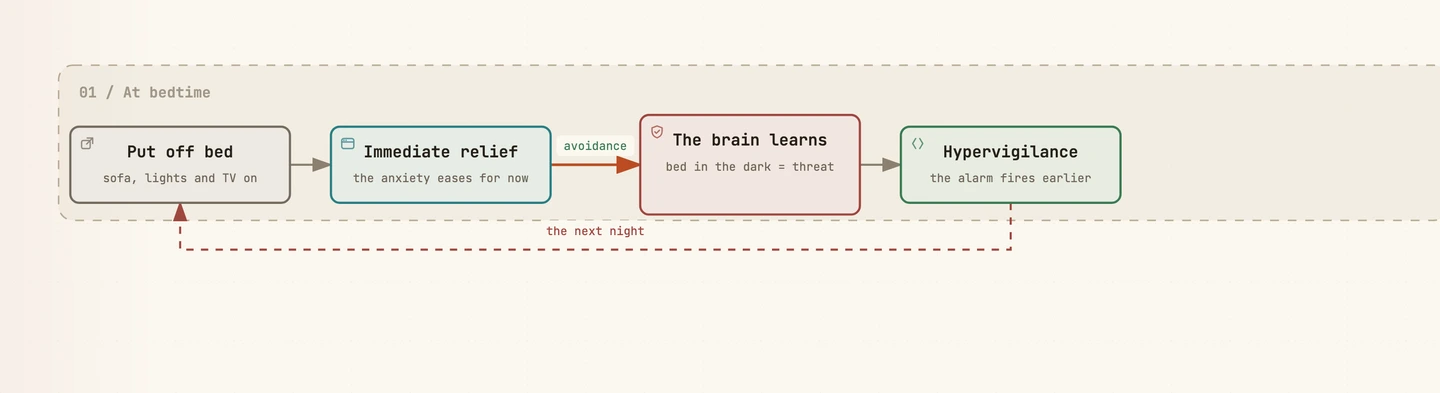
At night, with fewer distractions, attention turns to the body, and the fear finds room. Avoidance and hypervigilance form a self-feeding loop: the more you put off bed, the more the brain treats sleep as a threat. Difficulty initiating or maintaining sleep affects 44% of veterans with PTSD, against 5.5% of those without it (Mohsenin & Mohsenin, 2014).
When someone with somniphobia tries to sleep, or even thinks about it, the body fires anxiety responses that work against the relaxed state sleep onset needs (Sleep Foundation, 2026). The harder you push, the more awake you become.
Avoidance feeds the loop. Putting off bed, sleeping on the sofa, keeping the television on: each move brings relief in the moment and teaches the brain that the bed, in the dark, is a dangerous place. The next night, the alarm goes off earlier.
The triggers usually have a concrete origin. Cleveland Clinic lists nightmares, sleep paralysis, fear of dying in one’s sleep, hallucinations in the transition to sleep, and a history of trauma that happened at night (Cleveland Clinic, 2022). Sleep paralysis on its own affects around 7.6% of the general population (StatPearls, 2023).
In clinical practice, the trigger is almost never “sleep”. It is the moment of transition, when attention lets go and the person feels they are losing control. Focusing on that fraction of a second, rather than the whole night, tends to shift the picture faster.
Is sleep anxiety the same as somniphobia?
Not every anxiety around sleep is somniphobia. Cleveland Clinic uses “sleep anxiety” as a synonym for somniphobia, but the term circulates more widely (Cleveland Clinic, 2022). Worrying about the night ahead is not the same as fearing the act of falling asleep. An estimated 9.1% of US adults had a specific phobia in the past year (NIMH).
The term has two uses worth separating. The anxiety that blocks falling asleep is a state of activation at bedtime: the mind races, the body will not switch off. Somniphobia is fear of sleep itself, with deliberate avoidance. A person can have both, or only one.
When the main difficulty is worry, body alertness and fear of not being able to sleep, see sleep anxiety.
The overlap is real. Sleep Foundation notes that bedtime anxiety and fear of falling asleep are common symptoms of nightmare disorder and PTSD (Sleep Foundation, 2026). Even so, treating “sleep anxiety” as a synonym for somniphobia erases a distinction that is useful when you choose a route to help.
Among US adults who had a specific phobia in the past year, 21.9% of cases were serious, 30.0% moderate, and 48.1% mild (NIMH). That shows a wide spectrum: not every fear of sleep carries the same weight, and the intensity guides the response.
How to start sleeping again
The first-line approach for specific phobias is gradual exposure therapy (Sleep Foundation, 2026). It works by approximation: you meet the bed again in stages, learning to regulate anxiety at each one. CBT is described as a safe and effective option, and more than 90% of people who try exposure benefit from it.
Graded exposure is the gold standard for specific phobias, using systematic desensitisation, with a promising prognosis for those who complete a course (StatPearls, 2024). The work pairs this gradual return with anxiety regulation and small adjustments to routine.
Gradual exposure and safety anchors
Build a ladder of small steps. Sitting on the bed with the light on. Lying down clothed, for ten minutes, without trying to sleep. Lying down with the light lower. The rule is to stay long enough for the arousal to start dropping before you leave the situation.
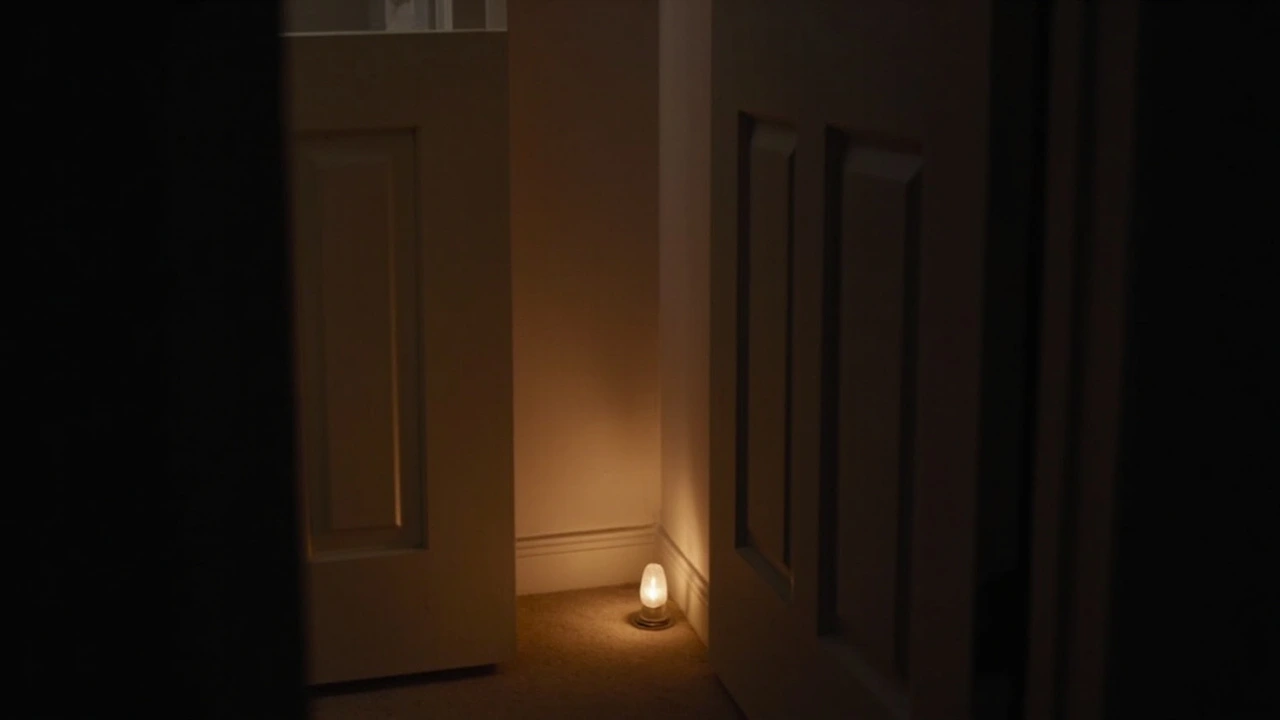
Safety anchors make this sustainable: a wind-down ritual that is always the same, a light you dim over weeks rather than cutting it all at once, slow and counted breathing, a calm audio track with no screen. They give the body something predictable.
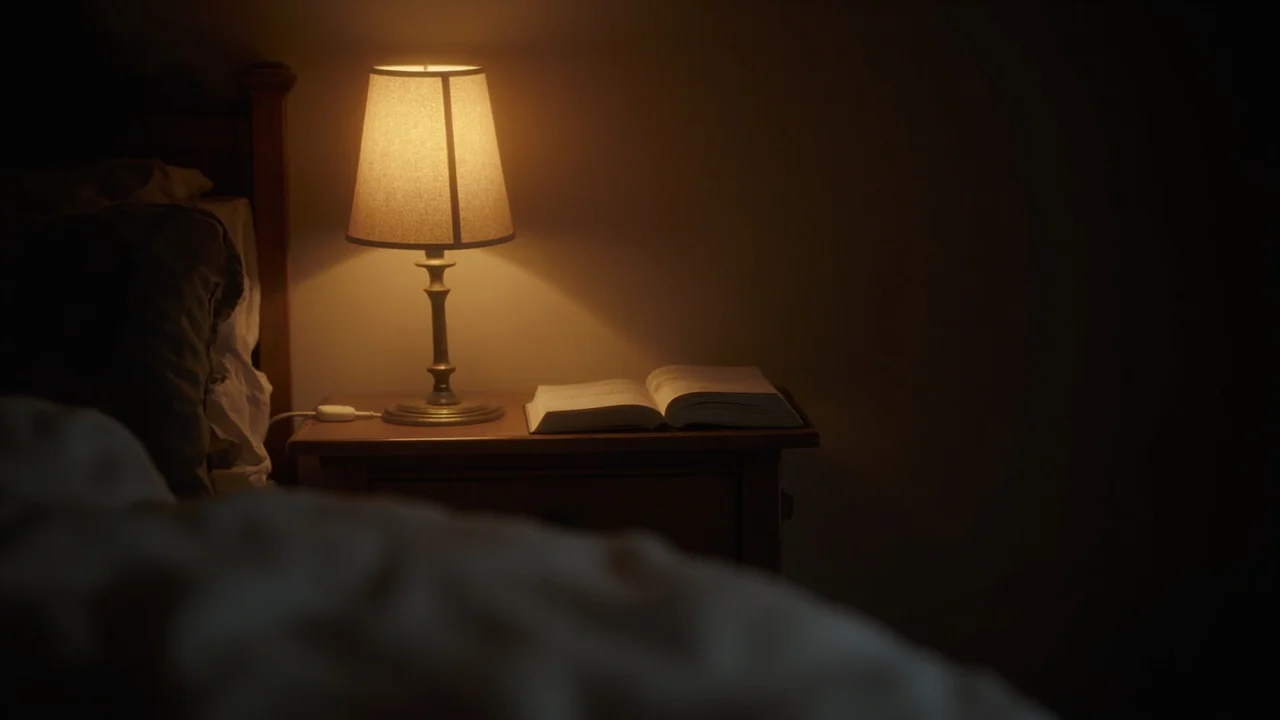
Sleep window
In somniphobia, the bed has become a lookout post. The sleep window gives it back its job as a place to sleep and supports the exposure work: you only lie down when sleep is coming, and you keep the same wake time every day. If you are wide awake and anxious, get up, do something monotonous in low light, and return when sleep comes. Lying there fighting the clock feeds the avoidance and the idea that the bed, in the dark, is dangerous. For routine and sleep environment, see the hypnotherapy approach to insomnia.
What not to do
Some habits look like help and keep the fear alive:
- Putting off bed again and again, or sleeping on the sofa to “trick” sleep.
- Running repeated checks: doors, windows, the clock, the breathing of the person next to you.
- Cutting every light at once, trying to fix everything in a single night.
- Using alcohol, or leaving the television on all night, as a crutch.
- Watching the hours. The clock becomes a scoreboard, and each glance restarts the alarm.
When I support someone through this, the step that shifts the picture most is often a plain one: turning the clock to face the wall. Without the number in view, the body stops calculating how much it has lost, and the arousal eases a little.
When should you get professional help?
Speak to a professional if you are spending more and more time avoiding sleep, or you feel panic at the thought of falling asleep (Sleep Foundation, 2026). It is also worth an assessment when there are trauma-linked nightmares, a recent bereavement, or loud snoring with breathing pauses. Nightmares are reported by 19% to 71% of patients with PTSD (Mohsenin & Mohsenin, 2014).
None of this is a diagnosis. These are signs that the fear has moved from a nuisance to a limitation, and that a face-to-face assessment helps map what sits underneath. If there is any suspicion of sleep apnoea or another medical condition behind the waking, see the main diseases that cause insomnia.
Treatment usually combines exposure therapy, CBT and, where there is trauma, EMDR, with sleep hygiene as support (Cleveland Clinic, 2022). The NHS lists talking therapies such as CBT, hypnotherapy and medicines among the options used for phobias, and advises seeing a GP if you think you have a phobia and the symptoms are affecting your life (NHS).
Medication is not the centre of treatment. Beta blockers or benzodiazepines can serve as short-term support for symptoms, never as a solution to the fear, and the decision rests with the doctor overseeing your care (Cleveland Clinic, 2022).
The same gradual-exposure logic applies to other specific phobias, such as the fear of vomiting: moving closer in small steps, never pushing the body past what it can tolerate at each stage.
Frequently asked questions
Is somniphobia curable?
It is more useful to think about management than cure. Specific phobias respond well to structured treatment: CBT through exposure therapy is the gold standard, with systematic desensitisation and a good prognosis for those who complete the process (StatPearls, 2024). Many people sleep again without the dread, even if hard nights still turn up now and then.
Is fear of sleep the same as insomnia?
No. Insomnia is not sleeping despite having the time and opportunity for it. Somniphobia is avoiding or fearing the act of falling asleep. Sleep Foundation highlights that somniphobia is distinctive because sleep is essential and cannot simply be avoided (Sleep Foundation, 2026). The two can coexist, but the treatment target differs.
Why am I afraid I won’t wake up?
Fear of dying during sleep is a recognised trigger for somniphobia (Cleveland Clinic, 2022). Often it is an anxious worry with no illness behind it. A medical review is worth having if there is loud snoring with breathing pauses, strong daytime sleepiness, or if the fear began after a recent loss, when grief may be at the centre.
Do sleeping pills help?
They do not treat the fear. Beta blockers or benzodiazepines can reduce symptoms in the short term, but they do not change the threat response tied to falling asleep, and they can reinforce avoidance if they become the only way to sleep (Cleveland Clinic, 2022). Any use is a decision for the doctor who follows your case.
Conclusion
Fear of sleep is treatable, even when it has lasted for years. The starting point is recognising the pattern: putting off bed, keeping lights and screens on, checking the clock and the surroundings, sleeping only through exhaustion. Each of these moves brings relief today and keeps the alarm set for tomorrow. The way back is usually gradual: bringing the body close to the bed again in small steps, with safety anchors and a steady sleep window, whilst you learn to tolerate the anxiety instead of fleeing it. Exposure therapy and CBT have the strongest evidence, and EMDR has a place when there is trauma. If the panic, the sleep loss or the nightmares persist, seek an assessment. To see how this work happens in practice, visit how it works. For those who lie awake replaying conversations and rehearsing how not to offend anyone, the people pleasing pattern can be part of what keeps the mind awake, and is worth reading alongside this guide.
About the author
Fabio Morus is a behavioural therapist and clinical hypnotherapist in Jersey, Channel Islands, focused on anxiety, phobias, sleep and trauma. He trained in Neuro-Systemic Hypnotherapy, CBT (Beck Institute) and EMDR (EMDR Association UK). He works online in Portuguese and English, and in person in Jersey.
This article is for information and does not replace a professional assessment. If you are struggling to cope, contact Samaritans on 116 123 (UK and ROI, free, 24/7). In Jersey, contact your GP, the emergency services, or the local crisis line.