

Imagine sitting in a doctor’s office. Your hands are trembling, your legs feel heavy, or maybe you’ve just had a seizure you can’t explain. Then the doctor looks at the screen and says: “Your MRI is perfectly clear. There is nothing wrong with your brain.”
For most people, this isn’t a relief. It’s a dismissal. It feels like the medical world is telling you that your symptoms are “all in your head.”
Here is the point: FND is real. It is not “made up,” it is not “faking,” and it is certainly not a lack of willpower.
Functional Neurological Disorder (FND) is one of the most common reasons people see a neurologist, second only to headaches. Yet, it remains one of the most misunderstood conditions in medicine. We’re going to break down the myths, look at the actual science, and show you why your symptoms are genuine even when the “hardware” tests say everything is normal.
Is FND Real? The Software vs. Hardware Analogy
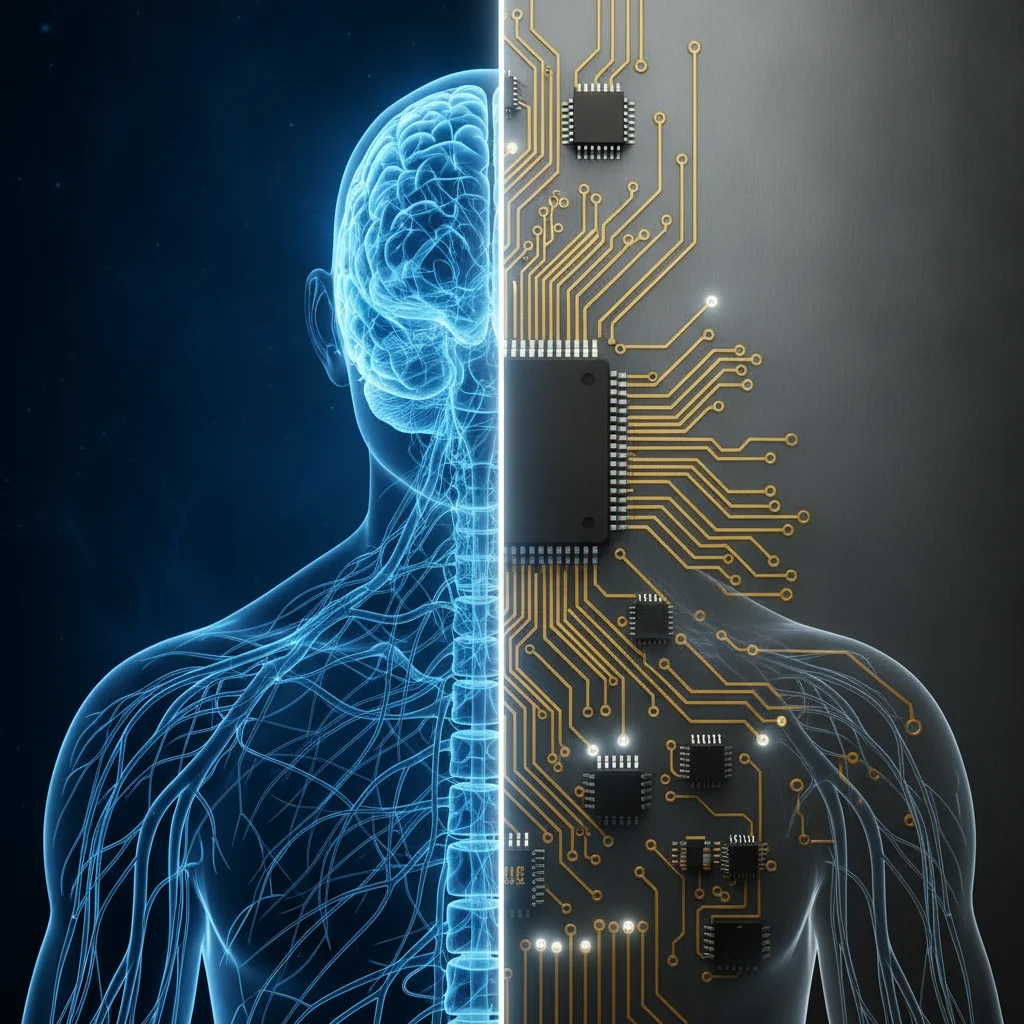
To understand FND, we need to change how we look at the brain. Most neurological conditions, like Multiple Sclerosis or a stroke, are “hardware” problems. If you opened the “computer” (the brain), you would see physical damage to the wires or the circuit board.
FND is a software problem.
Your brain’s “hardware”—the neurons and physical structure—is intact. But the “software”—the way the brain sends and receives signals—is glitching. Think of a computer that freezes while running a heavy program. The screen is black, the keys don’t work. Is the computer “broken”? Physically, no. But is the problem “real”? Absolutely. You can’t use the computer until the software is fixed.
In FND, the brain’s signaling pathways are disrupted. The brain is sending the “wrong” signals to the body, or failing to process the “right” ones. It’s not about damage; it’s about function.
Why Traditional Tests Fail (and Why That’s a Clue)
One of the biggest sources of stigma is the “normal” test result.
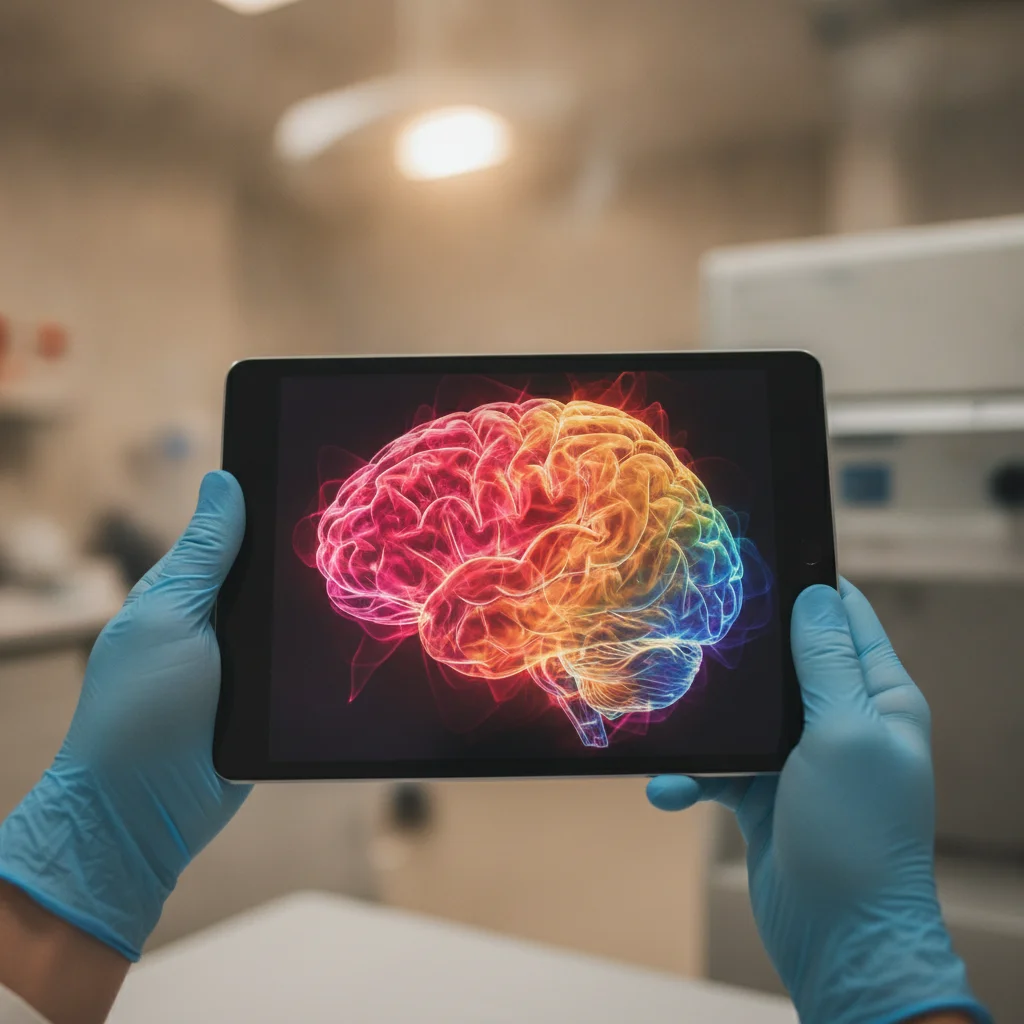
Standard imaging (MRI or CT) looks at the structure of the brain. It’s like taking a photo of a computer to see if the internet is working. The photo will look fine, but it won’t tell you anything about the connection speed.
To “see” FND, researchers use Functional MRI (fMRI), which measures brain activity in real-time. These studies show that in FND patients, there is hyper-connectivity between the emotional centers of the brain and the motor control centers.
This is the scientific proof: your brain is functioning differently, even if the structure hasn’t changed. The problem isn’t the part; it’s the process.

Common Myths: Is FND Real or Just Psychological?
Myth 1: “It’s just stress or anxiety.”
Stress can be a trigger, but many people develop FND during calm periods. It is a distinct neurological condition, not just an emotional reaction.
Myth 2: “If I just stop thinking about it, it will go away.”
FND involves the involuntary nervous system. You cannot “think” your way out of a functional seizure any more than you can “think” your way out of a migraine.
Myth 3: “FND is a diagnosis of exclusion.”
In the past, doctors only diagnosed FND when they couldn’t find anything else. Today, we use “positive signs”—specific physical tests like Hoover’s Sign—that prove the nervous system is functioning incorrectly. It is a “rule-in” diagnosis. We aren’t guessing.
The Mind-Body Connection: Not “Just Psychological”
Is FND psychological or neurological? The answer is: Yes.
The old medical divide between “mental” and “physical” is a myth. The brain and body are a single, integrated system. A “mental” trigger—like a past trauma or a period of intense pressure—can create a “physical” pathway in the brain.
When the brain gets stuck in a “fight or flight” loop, it can accidentally “re-wire” how it controls movement. This is neuroplasticity gone wrong. The good news is that if the brain can learn a “bad” software program, it can also learn a “good” one.

How Hypnotherapy and Neuroplasticity Help
Because FND is a signaling problem, treatment focuses on “re-training” the brain. This is where hypnotherapy actually makes sense.
Hypnotherapy works with the subconscious—the part of the brain that manages involuntary signals. By using visualization and targeted relaxation, we can:
- Lower the “noise”: Calm the overactive emotional centers interfering with motor signals.
- Re-establish the connection: Use mental rehearsal to remind the brain how to move correctly.
- Interrupt the loop: Break the cycle of “expectation” that keeps symptoms alive.
Neuroplasticity is the brain’s ability to change. By giving the brain new, healthy signals, we can “update” the software and reduce or even eliminate FND symptoms.
FAQ: Common Questions About FND
Is FND a permanent disability?
Not necessarily. Many people achieve significant recovery through specialized physical therapy, CBT, and hypnotherapy. The brain is remarkably adaptable.
Can FND be cured?
While “cure” is a complex word in neurology, many patients reach a state of remission where symptoms no longer interfere with their lives.
How do I explain FND to my family?
Use the software/hardware analogy. Tell them: “My brain’s hardware is fine, but the software that controls my movement is glitching. It’s like a phone that has a working screen but the apps are crashing.”
Conclusion: You Are Not Alone
If you have been struggling with FND, the most important step is accepting that your symptoms are real. Once you stop fighting the “stigma” of it being “all in your head,” you can start the real work of re-training your brain.
Your brain has the power to change. It created these pathways, and with the right tools, it can create new, healthy ones. Simple as that.
If you want a simple first step, download the free ANXIETY ZERO ebook. And if you feel you need more direct support, get in touch with Fabio Morus.