


Have you ever felt your heart race just thinking about speaking to a group? Glossophobia is much more than nervousness. It paralyzes millions, preventing them from speaking and achieving their dreams.
Over 75% of people experience anxiety when speaking in public. This condition is not temporary. It can limit your opportunities and affect your confidence.
Key Points
- Glossophobia affects up to 40% of the population.
- It can cause intense physical symptoms such as tremors and sweating.
- It directly impacts professional performance.
- Treatment is available and it is possible to overcome the condition.
- Breathing techniques can help control anxiety.
Glossophobia: What is it?
https://www.youtube.com/watch?v=a2QhIliMm1UThe fear of public speaking is a condition that affects many people. More than half experience a great deal of fear when speaking in public .
Glossophobia is not just a little nervousness. It's a very intense fear that can prevent a person from speaking in front of many people.
Medical Definition of Phobia
For doctors, glossophobia is an anxiety disorder. It is characterized by:
- Extreme fear of public speaking.
- intense physical symptoms in social situations
- Involuntary stress reactions
Difference Between Common Fear and Phobia
There are important differences between fear of public speaking and glossophobia:
| Common Fear | Glossophobia |
|---|---|
| Controllable anxiety | Debilitating anxiety |
| Occasional nervousness | Persistent and intense fear |
| It does not interfere with social life. | It limits professional opportunities. |
Impact on People's Lives
Glossophobia greatly affects people's lives. At work, it can cause:
- Lower likelihood of promotions
- Presentation freezes
- Limitations in strategic communications
Overcoming the fear of public speaking greatly helps in both personal and professional life. Seeking help is the first step in overcoming this barrier.
Is Glossophobia Curable? Main Symptoms of Glossophobia

Glossophobia, or fear of public speaking, affects 75% of the world's population. Knowing the symptoms helps to understand and treat this condition that affects millions.
The symptoms of glossophobia vary greatly from person to person. Knowing what causes glossophobia helps in dealing with this complex condition.
- Intense physical symptoms
- Specific psychological reactions
- Profound emotional impact
Key manifestations of glossophobia include:
| Symptom Category | Description |
|---|---|
| Physicists | Tremors, sweating, tachycardia |
| Psychological | Extreme anxiety, intense fear |
| Behavioral | Avoiding social situations |
The good news is that glossophobia is treatable! Therapy, breathing techniques, and gradual exposure can help overcome the fear.
Studies by the American Psychological Association (APA) show that traumatic experiences and low self-esteem contribute to glossophobia. Knowing what causes the fear is the first step to overcoming it.
- Seek professional help.
- Practice relaxation techniques.
- Gradually expose yourself to public speaking situations.
Remember: you are not alone. With support and commitment, it is possible to overcome the fear of public speaking and regain your confidence.
Physical Manifestations of Fear of Public Speaking

Glossophobia causes the body to react in various ways. This happens because the body reacts to the stress of public speaking.
A study in the United Kingdom showed that many people are afraid of public speaking. 41% of those surveyed said they have this fear. This is more common than the fear of death or financial problems.
Cardiac and Respiratory Changes
When the stress of glossophobia arises, the body changes significantly:
- The heart rate increases.
- Blood pressure rises.
- Breathing becomes faster and shallower.
- Someone might feel a tightness in their chest.
Sweating and Tremors
In addition, there are other common physical symptoms:
- Excessive sweating, especially on the hands.
- Tremors that cannot be controlled.
- Larger pupils
- Facial blush
Mental Block and Difficulty Expressing Oneself
Hypnosis can be very helpful for glossophobia. It helps to control the body and mind, allowing one to speak with more confidence.
Many people avoid public speaking because of fear. But with practice and relaxation, it's possible to overcome that fear.
Psychological Causes of Glossophobia
Glossophobia is a phobia that affects many people. It arises when we speak in public. At that moment, our body reacts as if it were in danger.
- Traumatic experiences of rejection in childhood
- Low self-esteem
- Intense fear of judgment
- Negative thought patterns
Hypnotherapy can help change these negative patterns. About 75% of people feel anxious when speaking in public. This shows that it is a common challenge.
| Psychological Origin | Impact |
|---|---|
| Childhood traumas | Persistent fear of exposure |
| Frequent criticisms | Emotional block |
| Low self-confidence | Avoidance of social situations |
Hypnotherapy works with the subconscious. It helps change the way we view public speaking. As a result, people learn to handle these situations better.
Understanding the psychological causes is the first step in overcoming glossophobia. This helps to regain confidence when speaking in public.
Differences Between Glossophobia and Socialophobia
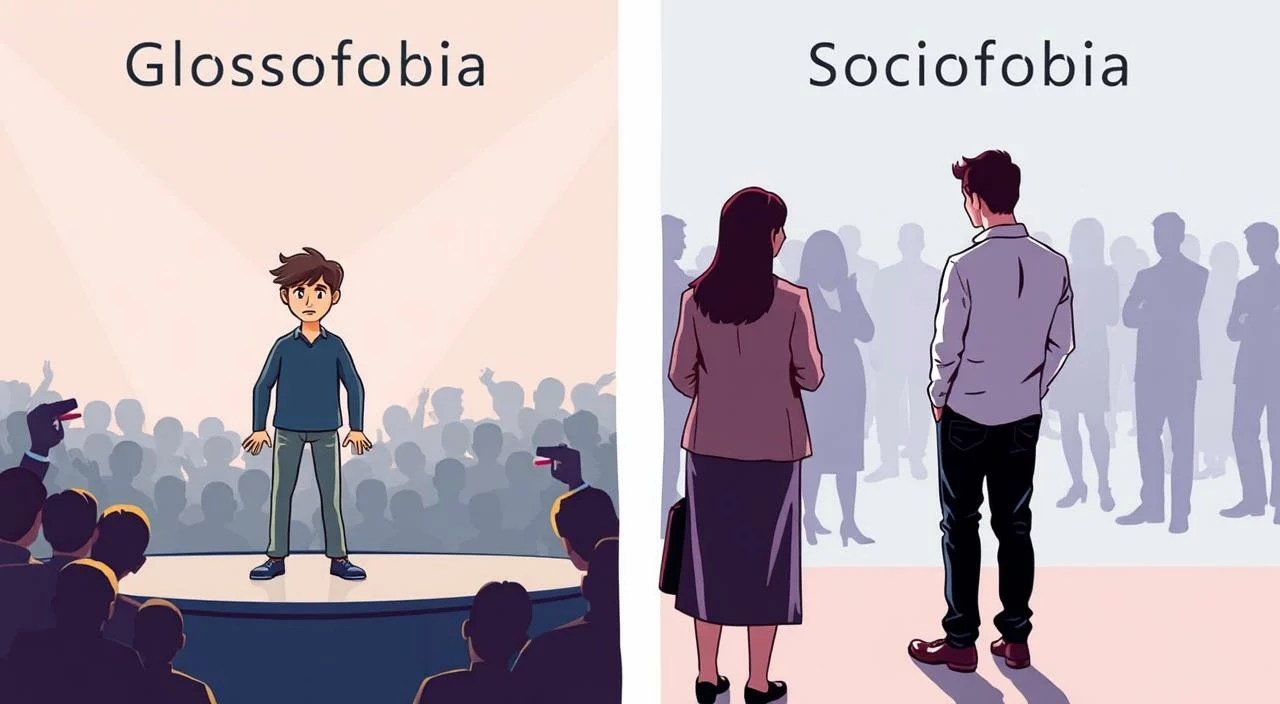
Many people confuse glossophobia with social phobia. But they have important differences. Let's look at these differences to better understand each one.
Specific Characteristics of Each Condition
Glossophobia is a fear of public speaking. Social phobia, on the other hand, is a broader fear of being around other people. Let's look at the main differences:
- Glossophobia: Fear restricted to situations involving public speaking.
- Social phobia: A generalized fear of social interactions.
- Glossophobia primarily affects oral communication.
- Social phobia impacts various aspects of social relations.
How to Identify Your Condition
To find out if you have glossophobia or social phobia, consider the following points:
| Glossophobia | Social phobia |
|---|---|
| Specific fear of public speaking | Widespread fear of social interactions |
| Symptoms appear in presentations | Symptoms in various social situations |
| Localized anxiety during speaking. | Constant anxiety in social settings |
Hypnosis treatment can help with both glossophobia and social phobia. This technique reduces anxiety and changes negative thoughts about public speaking.
Remember: Every case is unique. Accurate identification requires evaluation by a qualified mental health professional.
The Impact of Glossophobia on Professional Life

Glossophobia can be a major obstacle to career growth. Around 20% of the population has a very strong fear of public speaking. This greatly affects their chances of career advancement.
This fear can cause major problems. It can severely limit what a person can do at work. The main problems include:
- Loss of promotion opportunities
- Difficulty in presenting projects and ideas.
- Reduced visibility in the workplace.
- Limitations in roles that require communication.
Glossophobia has a significant impact. Studies show that 50% of professionals avoid public presentations . This can be very detrimental, even for someone who is very good at their job.
One solution could be hypnosis. It can help restore confidence and improve public speaking skills.
There are ways to overcome glossophobia at work. Practice, therapy, and self-awareness are some of them. They can make communication safer and more effective.
Available Treatments for Glossophobia

Glossophobia can be a major challenge. However, there are several effective strategies to overcome it. Knowing about treatments can help those who are afraid of public speaking feel more confident.
Recommended Therapies
Cognitive behavioral therapy (CBT) is widely used to treat glossophobia. It helps to:
- See negative thought patterns
- Developing ways to cope with fear.
- Rebuilding beliefs about public speaking
Medical Approaches
In some cases, doctors may suggest additional treatments. These may include:
- Medications to help control anxiety
- Therapy combined with psychological support.
- An assessment to see what each person needs.
Self-help techniques
Hypnosis is a powerful tool against glossophobia. It helps to:
- Reduce anxiety
- Treating traumas and blockages
- Increase confidence when speaking in public.
Studies show that 77% of people experience some level of anxiety when speaking in public. This shows that you are not alone on your journey to overcome this.
How Hypnosis Can Help in Treatment
Hypnosis helps those who are afraid of public speaking. It accesses the subconscious, where fears and limiting beliefs reside.
In hypnosis treatment, some strategies are essential:
- Reprogramming negative mental patterns
- Reducing anxiety before presentations
- Building self-confidence
- Transforming limiting thoughts
Clinical hypnosis changes negative thoughts into positive ones. For example, "I'm going to stutter" becomes "I am able to communicate clearly." This greatly reduces the fear of public speaking.
Techniques such as positive visualization and hypnotic suggestions are used. They help to create a new way of thinking. Studies show that patients improve significantly in just a few sessions.
| Benefits of Hypnosis | Expected Results |
|---|---|
| Reducing anxiety | Up to 70% fewer symptoms |
| Increased self-confidence | Improved communication |
| Reframing fears | Emotional transformation |
Hypnosis for glossophobia is a non-invasive and personalized method. It helps people overcome their fears and communicate more confidently.
Breathing and Relaxation Techniques
Controlling your breathing is very helpful in overcoming the fear of public speaking. Around 75% of people feel anxious during presentations. Breathing techniques can reduce this anxiety.
Deep breathing slows the heart rate. It also helps to relax the muscles. Studies show that these techniques can:
- Reduce heart rate by up to 20% during stressful situations.
- Increase lung capacity by 25%
- Improve vocal clarity by approximately 30%.
Hypnosis can also help with the fear of speaking. Combining these breathing techniques can make you feel calmer and more confident.
| Breathing Technique | Benefits |
|---|---|
| Diaphragmatic Breathing | Increases brain oxygenation by 15%. |
| Alternate Nasal Breathing | Reduces anxiety by up to 40%. |
| Controlled Breathing | Improves mental clarity. |
Practice these techniques regularly to gain more emotional control. The key is consistency and mindful practice . Remember, 90% of people improve significantly after learning these techniques.
Important tip: Before speaking, take a few minutes of deep breathing. This calms your nerves and prepares your body and mind.
Practical Exercises to Overcome Fear
To combat glossophobia, a lot of practice is essential. Gradual exposure to public speaking helps reduce anxiety. Hypnosis can also strengthen confidence during this process.
Simple exercises can boost confidence. Practice imaginary speeches in various settings. This prepares your brain for real-life speaking situations, helping to reduce fear.
Recommended Daily Practices
Daily communication exercises are important. Practice breathing exercises and self-improvement techniques. Record yourself speaking and analyze your posture and body language. Hypnosis can help with the psychological aspects of fear of public speaking.
Gradual Exposure
Start with small groups and smaller meetings. Gradually increase your exposure. Each presentation is a chance to learn and lessen your fear. Consistent practice is the key to overcoming this challenge.
Source Links
- Fear of public speaking: Why does it happen? - Speaking Club - Online and In-Person Public Speaking Course
- What is Glossophobia? Symptoms of fear of public speaking.
- Glossophobia? Medical term for fear of public speaking.
- What is glossophobia? See 5 signs of fear of public speaking.
- Glossophobia
- Glossophobia: Understanding and Overcoming the Fear of Public Speaking
- Fear of public speaking: what it is and how to overcome it.
- Tips for overcoming Glossophobia (Fear of public speaking). | Insights and Reflections
- Fear of public speaking is greater than fear of death, study says.
- glossophobia
- Fear of public speaking: a guide to overcoming it.
- What is the difference between glossophobia and social phobia? - Pedagogy
- Glossophobia: fear of public speaking
- Glossophobia: fear of public speaking - Communication and Public Speaking
- Pilot study of glossophobia in the context of university students.
- Fear of Public Speaking: Glossophobia Explained
- Glossophobia – The Fear of Public Speaking
- Most common phobias: symptoms, causes, and treatments
- How to Overcome the Fear of Public Speaking: Effective Strategies Revealed
- Overcoming phobias with clinical hypnosis - Hypnosis Salvador
- Discover what a phobia is and how hypnosis can help.
- What is Glossophobia: Understanding This Fear
- Are you afraid of public speaking? - UniDomBosco Blog
- Breathing and public speaking - Communication and Public Speaking
- Glossophobia: fear of public speaking | Complete Public Speaking Course
- How to overcome the fear of public speaking with 10 behavioral practices.
- Glossophobia: How to overcome the fear of public speaking? - Official Blog of Senac SC
🌟 Have you considered seeking a therapist to support your well-being journey?
If this article sparked reflections about positive changes in your life, perhaps now is the ideal time to take the next step. Do you know hypnosis as a therapeutic tool? This approach can be surprisingly effective for various personal challenges.
Special offer: Book a free 20-minute consultation with therapist Fabio Morus and discover how therapy can transform your life.
✨ No commitment — Completely free — 20 minutes that can make a difference
👉 Click here to book your free consultation
Don't postpone your well-being any longer. The first step to change is just one click away.