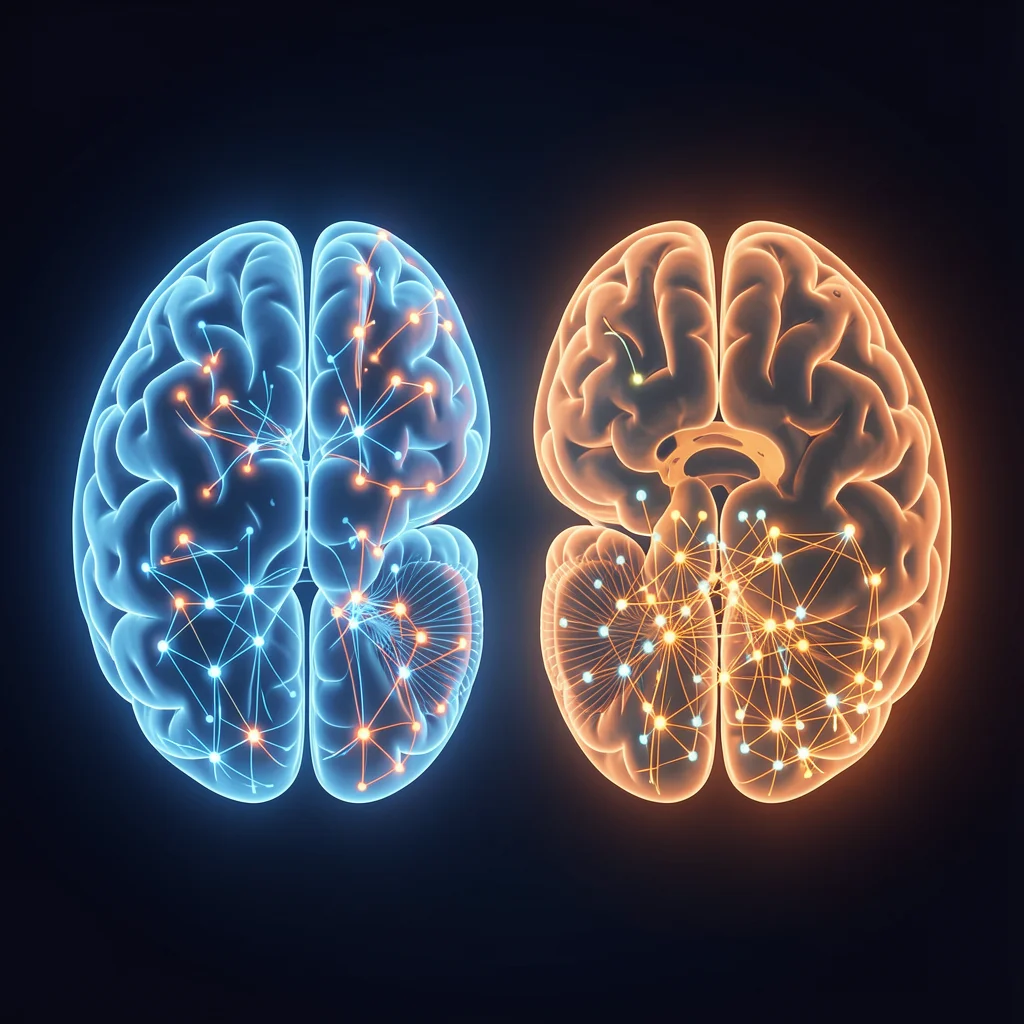

FND and multiple sclerosis (MS) share symptoms. Both can cause weakness, fatigue, balance problems, and sensory changes. But they are fundamentally different conditions.
The Key Difference
MS is an autoimmune disease that causes physical lesions in the myelin—the protective layer surrounding nerves. These lesions are visible on MRI scans.
FND does not cause structural damage. The brain is intact—but it functions differently. It is a software glitch, not a hardware problem.
How Can They Be Distinguished?
| Characteristic | FND | Multiple Sclerosis |
|---|---|---|
| Imaging tests | Normal | Visible lesions |
| Progression | Fluctuating | Typically progressive |
| Response to distraction | Improves | No change |
| Typical age | Any age | 20–40 years |
| Cause | Functional | Autoimmune |
Why This Matters
Many patients with FND spend years being evaluated for MS. They receive the wrong diagnosis, undergo unnecessary treatments, and become increasingly frustrated.
When the correct diagnosis finally comes, the relief is real. Knowing that you don’t have a progressive degenerative disease changes everything.
But the next challenge is just as important: finding the right treatment. Because FND, while not degenerative, is real. And it deserves to be treated with the same seriousness.
Read more about the treatments available for FND.
What to Watch After Differential Diagnosis
Once neurological assessment and tests point toward FND rather than multiple sclerosis, the focus changes. The question is no longer “which lesion appeared?” but “which patterns make the symptom worse or better?” This matters because functional symptoms often vary with attention, stress, fatigue, sleep, and a person’s sense of safety.
In practice, it helps to record when weakness, tremor, or sensory change appears, how long it lasts, and what helps you regain stability. Bring these observations to professionals familiar with FND, functional neurological physiotherapy, trauma-informed therapy, and nervous-system regulation. The goal is not to prove that the symptom exists. It does. The goal is to find the conditions in which the brain can access movement and sensation more reliably.
That record also helps appointments become more practical. Instead of spending the whole consultation retelling the fear of MS, you can discuss triggers, recovery windows, functional signs, and treatment priorities. This makes the next step clearer and less frightening.
Note: This article is for informational purposes only. Consult a neurologist for a differential diagnosis.