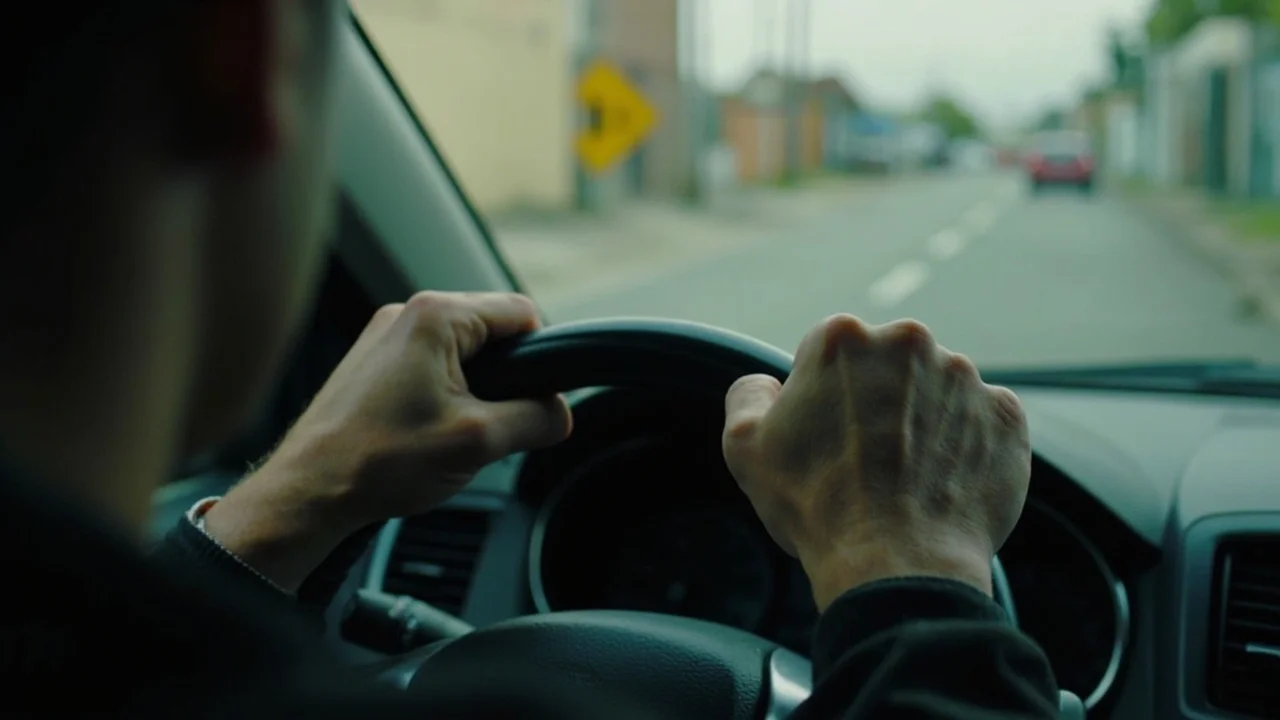

Overcoming fear of driving usually means gradual exposure to the situations you’ve been avoiding, not sheer willpower. Cleveland Clinic estimates that up to 90% of people with a specific phobia improve with exposure-based treatment (Cleveland Clinic, 2024). The path forward is progressive: map your triggers, train your breathing, and move through the steps, alone or with professional support.
Key Takeaways
- Fear of driving (amaxophobia) is treated as a specific phobia when it lasts 6+ months and disrupts daily life.
- Up to 90% of people with specific phobias improve with gradual exposure (Cleveland Clinic, 2024).
- A pilot study using virtual reality found 93% success maintained after 12 weeks (Kaussner et al., PLoS One, 2020).
- New-driver nerves tend to fade with practice; an established phobia involves persistent avoidance.
On this page
- What is driving phobia (amaxophobia)?
- What are the physical and mental symptoms behind the wheel?
- Why do some people develop a fear of driving?
- Normal new-driver nerves or an established phobia?
- Is fear of driving common?
- How to overcome fear of driving in practice
- A breathing protocol to use behind the wheel
- When should you seek therapy or hypnotherapy?
- Frequently asked questions
- About the author
What is driving phobia (amaxophobia)?
Amaxophobia is the clinical name for an intense fear of driving or riding in a car, and it affects a share of people trying to get back behind the wheel after a scare (Cleveland Clinic, 2024). It also appears under the names hamaxophobia, motorphobia or ochophobia, depending on the source consulted.
There’s also a more specific term, vehophobia, used when the fear centres on driving itself rather than on being a passenger (Talkspace). In practice, many people use the two terms interchangeably, and that doesn’t change the treatment.
The DSM doesn’t list amaxophobia as its own disorder. Clinicians typically frame it as a specific phobia when the fear or avoidance persists for six months or more and significantly impairs daily functioning (Cleveland Clinic, 2024). The NHS confirms this general logic: specific phobias have a single trigger, unlike complex phobias such as agoraphobia, which have a wider impact (NHS, 2026). For a closer look at this distinction, see the complete guide on anxiety: symptoms, causes and treatment.
That distinction is clinical, not an automatic diagnosis. Feeling tense behind the wheel after a scare doesn’t, on its own, mean a phobia has taken hold.
| Sign | Common nervousness | Specific phobia |
|---|---|---|
| Duration | Weeks, fades with practice | 6 months or more |
| Avoidance | Absent or occasional | Persistent and growing |
| Functional impairment | None | Significant in daily life |
Clinical threshold per Cleveland Clinic, 2024.
What are the physical and mental symptoms behind the wheel?
The most common symptoms combine bodily reactions with alarming thoughts, according to Cleveland Clinic: palpitations, dizziness, trembling, excessive sweating, nausea, shortness of breath and stomach upset (Cleveland Clinic, 2024).
On the cognitive side, people commonly fixate on accident statistics, fear being hurt or dying, or fear losing control of the vehicle in traffic (Cleveland Clinic, 2024). Anxiety Care UK describes this as a fight-or-flight response triggered “in situations where there is no real need for it”, with chest pain, difficulty breathing and, in more severe cases, panic attacks with a fear of dying or losing control (Anxiety Care UK).
The NHS lists a very similar set of symptoms, independently: dizziness, palpitations, chest tightness, nausea, trembling, gastrointestinal discomfort and severe anxiety, with fear of fainting, losing control or dying (NHS, 2026). Two separate clinical sources describing the same picture helps confirm that these symptoms aren’t “an overreaction”.
Beyond the physical symptoms, there’s a typical behavioural pattern: avoiding motorways, bridges, tunnels or night driving. This kind of avoidance brings relief in the moment, but tends to keep the fear alive over the medium term.
There’s also a reassuring point for anyone who’s already had a panic episode behind the wheel. Anxiety Care UK, a British organisation specialising in phobias, notes that even the worst panic attacks leave no lasting effects: people don’t die, don’t lose their minds, and don’t lose control to the point of causing a crash (Anxiety Care UK). The sensation is real; the feared catastrophe doesn’t happen.
Why do some people develop a fear of driving?
The most commonly cited cause in the clinical literature is a prior traumatic experience, such as being involved in or witnessing a serious accident (Cleveland Clinic, 2024). But not every case has a single, identifiable event behind it.
Family history of anxiety also plays a role. Growing up around someone who already showed fear behind the wheel can teach the body to associate driving with danger, even without a personal accident (Cleveland Clinic, 2024). That’s a form of learning by observation, not direct experience.
One important point, raised by psychiatrist Fredric Neuman, is that driving phobia often appears as an extension of panic disorder or agoraphobia. The core fear, in these cases, centres on the idea of “not being able to escape” the situation if something goes wrong, rather than on driving itself (Psychology Today, 2012). This changes the focus of treatment: working on driving skill alone may not resolve things if the root cause is a fear of being trapped.
Other common situational triggers include fear of judgement from other drivers, heavy traffic and the idea of driving alone (Talkspace). Anxiety Care UK also notes that many cases develop gradually, without a single turning-point moment (Anxiety Care UK).
A pattern that isn’t well studied but comes up often anecdotally in English-speaking countries: repeated driving-test failures, or a harshly critical driving instructor, can leave a similar mark. It isn’t a single dramatic event, but it can still teach the brain to associate driving with judgement and failure.
Normal new-driver nerves or an established phobia?
The clearest distinction lies in avoidance behaviour: ordinary nervousness doesn’t force someone to avoid driving, whereas phobia is defined precisely by that avoidance, which reinforces itself over time (Anxiety Care UK). Avoiding the situations that frighten you tends to make you more sensitive to them, not less.
The clinical threshold Cleveland Clinic uses helps separate the two pictures: symptoms need to persist for at least six months and significantly impair daily functioning to warrant a specific phobia diagnosis (Cleveland Clinic, 2024). Talkspace describes a similar pattern when discussing vehophobia.
In practice, this means breaking into a cold sweat the first time you drive on a motorway, or feeling tense while parallel parking, doesn’t point to a phobia. What does point to one: still feeling the same level of fear after months of practice, or refusing trips, changing routes, or relying on someone else to drive.
It’s common to see clients who’ve avoided motorways for years but drove normally before one specific scare, as if they’d “become a new driver again” despite decades behind the wheel. The comparison helps explain the process without sounding alarming: the body relearned to fear something that used to be routine, and gradual exposure brings that back step by step.
If the fear has already lasted months, and it’s already changed your routes, your schedule or your reliance on others, that may indicate something beyond ordinary nervousness. Consult a mental health professional for an assessment rather than trying to self-diagnose. The same six-months-plus-impairment criterion applies to other common specific phobias, such as fear of the dark.
Is fear of driving common?
Specific phobias in general aren’t rare: roughly 1 in 10 American adults and 1 in 5 adolescents will experience a specific phobia at some point in life (Cleveland Clinic, 2024). Fear of driving falls within that broader category.
There’s no isolated figure specifically for amaxophobia among the sources verified for this article. For that reason, we’ve avoided citing statistics from other sources that couldn’t be directly confirmed. The figure on specific phobias is enough on its own to show the problem is common, not a sign of personal weakness.
Most people who feel some discomfort behind the wheel never actually meet the criteria for a phobia. The distinction from the previous section, between passing nervousness and persistent avoidance, remains the most useful way to work out where you stand.
| Population | Lifetime prevalence of a specific phobia |
|---|---|
| Adults (US) | About 1 in 10 |
| Adolescents (US) | About 1 in 5 |
Source: Cleveland Clinic, 2024.
A pattern that comes up often in practice is someone minimising their own fear (“it’s just nerves”) until they notice they’ve already changed their routine to avoid driving.
How to overcome fear of driving in practice
The treatment with the strongest evidence base is gradual exposure, in which a person approaches feared situations in small steps rather than avoiding everything or forcing it all at once. Cleveland Clinic reports improvement in up to 90% of specific phobia cases treated this way (Cleveland Clinic, 2024).
The NHS describes the process in very practical terms: list the driving situations you fear, rate each one for difficulty from 0 to 10, and work from the easiest to the hardest (NHS). You might start by sitting in a parked car, then driving in the driveway, then on a quiet street, and only later move on to traffic or motorways.
The NHS lists CBT among the talking therapies used to treat phobias in general (NHS), and Talkspace, drawing on its own clinical guidance, describes CBT as the most common vehicle for delivering this exposure work in driving phobia specifically (Talkspace). A therapist helps organise the fear hierarchy and paces the process, which reduces the chance of giving up partway through.
An alternative gaining ground is virtual reality exposure. A pilot study followed 14 patients with driving phobia through five sessions of exposure in a driving simulator: 100% mastered at least one previously avoided driving task, 71% showed adequate real-world driving behaviour after treatment, and 93% maintained that success after 12 weeks of follow-up (Kaussner et al., PLoS One, 2020). The authors themselves call the result “very promising”, but call for larger clinical trials before generalising.
With 14 participants and no control group, this is an early signal, not a settled finding.

A breathing protocol to use behind the wheel
Controlled breathing doesn’t treat the phobia on its own, but it works as an in-the-moment coping tool alongside exposure work, according to the NHS (NHS). Use it when you feel your body tensing up, before deciding to pull over.
A simple protocol is box breathing, done in four equal counts. Before setting off, or while stopped at a red light, try this:
- Breathe in through your nose, counting to 4.
- Hold the breath, counting to 4.
- Breathe out through your mouth, counting to 4.
- Hold with empty lungs, counting to 4.
Repeat this cycle three to five times. The point isn’t to eliminate the fear instantly, it’s to give your body a predictable anchor while the feeling passes. Many people report that the counting alone is enough to distract from a spiral of catastrophic thoughts.
Practise this pattern outside the car first, at home, seated, with no pressure at all. Getting behind the wheel already knowing the cycle by heart reduces the chance of “forgetting how to breathe” at the exact moment you need it most.
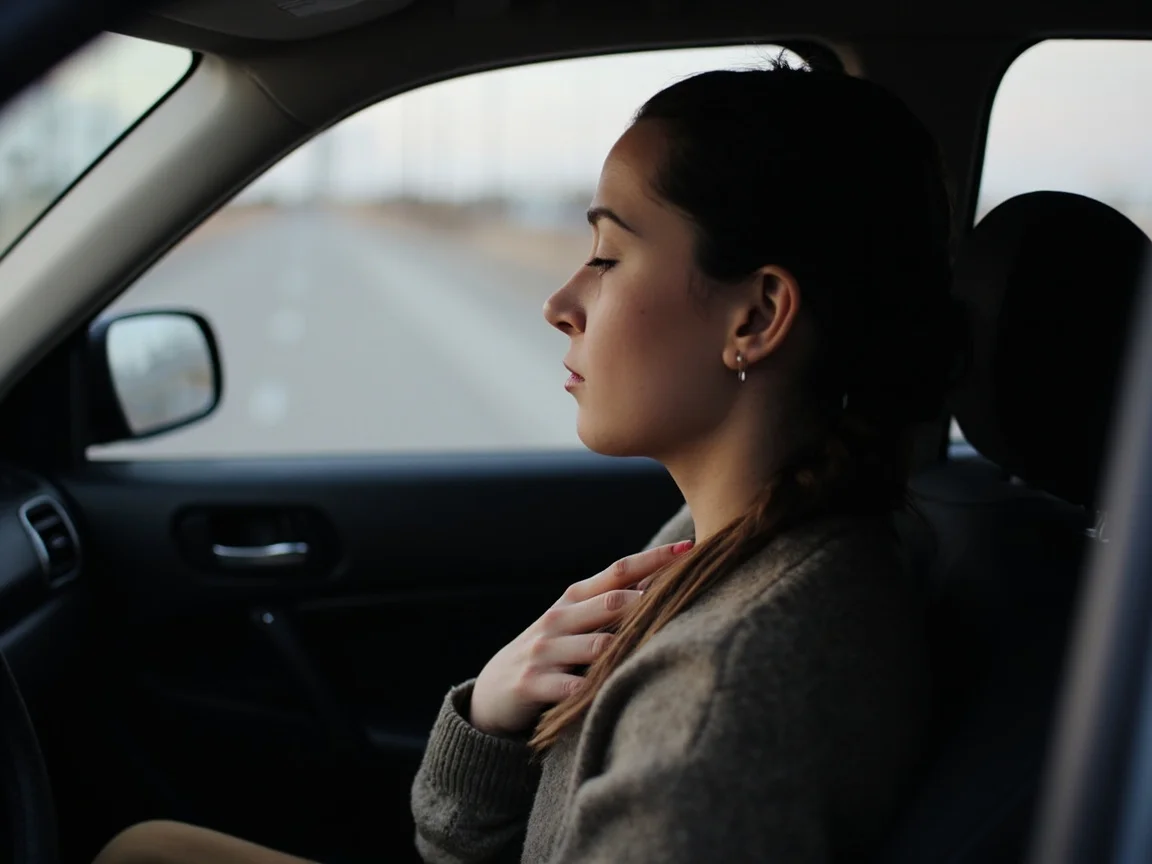
What if panic starts while you’re already driving?
The priority shifts from psychological to road-safety. Before any breathing technique, get the car out of the flow of traffic:
- Signal and slow down gradually, without braking sharply.
- Pull onto the shoulder or the nearest safe spot on the right and switch on the hazard lights.
- Only once stopped, with the car in neutral and the handbrake on, start the breathing cycle.
- Wait for the feeling to subside before driving again. If it doesn’t, call someone rather than forcing yourself back on the road.
It helps to know, while it passes, that Anxiety Care UK describes panic symptoms as intense but without lasting effects (Anxiety Care UK). If the episodes repeat behind the wheel, or you felt chest pain, get medical assessment before continuing to drive: panic symptoms and cardiac symptoms can look alike, and only a professional can tell them apart.
When should you seek therapy or hypnotherapy?
Seek professional support when the fear has already lasted months, has already changed your routine, or has already reduced your independence, even without a formal diagnosis. The NHS lists CBT, hypnotherapy and, in some cases, medication (antidepressants, beta-blockers, sedatives) among the options used to treat phobias in general (NHS).
One practical sign that it’s time to get help is noticing the avoidance spreading: you stopped driving at night, then stopped taking motorways, then started refusing entire trips. This kind of gradual widening is typical of phobias that go without intervention.
Hypnotherapy can be useful as part of this process when the fear of driving is closely tied to the body’s automatic response: the heart races before the mind even “decides” to be afraid. The NHS lists hypnotherapy as one of the recognised treatment routes for phobias, alongside CBT (NHS); in practice, it’s typically used as a complement to gradual exposure, not a replacement for it. For more on how a session works, see hypnotherapy for anxiety. In clinical experience, fear of driving tends to respond well when exposure work is paired with body-regulation techniques, not just willpower.
This doesn’t replace medical assessment when symptoms are intense or panic disorder is suspected. Consult a mental health professional to investigate the exact origin of the problem before choosing a treatment path.
| Approach | How it works | Best suited when |
|---|---|---|
| Gradual exposure (self-guided) | List feared situations, rate difficulty 0-10, work through step by step | Recent fear, no panic attacks, motivated to practise alone |
| CBT with a therapist | Structured exposure plus restructuring catastrophic thoughts | Fear installed for months, avoidance spreading to more situations |
| Virtual reality (pilot study) | Exposure sessions in a driving simulator | Access to the technology, preference for a controlled setting before the real road |
| Hypnotherapy | Complements exposure work, targets the body’s automatic response | Fear closely tied to physical reaction (racing heart, panic), alongside another approach |
Frequently asked questions
Can fear of driving be cured?
Most people with a specific phobia improve with gradual exposure, and Cleveland Clinic reports up to 90% improvement with this type of treatment (Cleveland Clinic, 2024). A definitive “cure” varies from person to person, but significant reduction is a common and realistic outcome.
Are amaxophobia and vehophobia the same thing?
They’re close, but not identical. Amaxophobia tends to describe a broader fear of vehicles, including being a passenger; vehophobia is the more specific term for the fear of driving itself (Talkspace). In clinical practice, both are treated in a similar way.
How long does it take to overcome fear of driving?
There’s no fixed timeline in the sources consulted. The process depends on the severity of the fear, the consistency of gradual exposure and individual factors. The NHS describes the work as incremental, moving step by step as difficulty decreases (NHS).
Is new-driver nervousness the same as a phobia?
Not necessarily. Ordinary nervousness tends to fade with practice and doesn’t require avoidance. Phobia is characterised by persistent avoidance that lasts six months or more and impairs daily functioning (Cleveland Clinic, 2024).
Does hypnotherapy work for fear of driving?
It can help some people, especially when the fear shows up as an automatic bodily response. The NHS lists hypnotherapy among the recognised treatment routes for phobias in general (NHS), but it tends to work best combined with gradual exposure work.
Overcoming Fear of Driving: Where to Start
Overcoming fear of driving rarely happens all at once. It involves understanding the symptoms, recognising the likely cause, and following a gradual exposure plan, with or without professional support. The evidence points to a realistic path: up to 90% improvement with exposure, according to Cleveland Clinic, and promising results even in newer formats such as virtual reality exposure.
If you’ve been trying for months without progress on your own, or if the fear has already changed your routine, it’s worth considering therapy or hypnotherapy as a next step. A professional can help build the right exposure hierarchy for your case and guide the pace with more confidence than trying alone.
About the author
Fabio Morus is a therapist based in Jersey, trained in Neuro-Systemic Hypnosis, CBT and EMDR. His clinical work focuses on anxiety, phobias, sleep, trauma and functional symptoms, with sessions available in Portuguese and English.